
H-bar 𝜓=0

The best laid schemes o’ Mice an’ Men/ Gang aft agley
This “series” has, as Robert Burns would say, “gang aft agley.” It started out with mindless AI and has meandered in the meanwhile among a menagerie of mesmerizing mammals: whales, deer, herons, seals, and now that towering giraffe. Maybe when it’s all done I will see some pattern that makes sense, which is what I hope I’ll see in my similarly “aft agley” life once I’m outside it. But the series is not “done,” and neither am I. So I press on.
I had a hard time deciding how to title this piece. I considered Buddy Holly’s “True Love Ways,” such a sweet, soothing song celebrating the best kind of love. Or a line from a poem I wrote this morning for my Instagram that opens with the fragrance of this year’s extravagant lilacs in my dooryard, alights briefly on a couple of Walt Whitman’s most famous poems, and closes with an instant transition “from breath to death and back again.” I think you’ll see how each of these might apply along the way here.
I decided finally on the enigmatic equation above, the one Bryce Dewitt concocted back in 1967, which purports to be the wave equation for the whole of what we now call the multiverse. Dewitt called it “damnable” because it is the only fundamental equation in physics that contains no “t” for time, implying that at the grandest scale time simply doesn’t exist, so nothing ever changes. Parmenides suggested something similar 2500 years ago, saying that being is-always, non-being is not-ever, the same astonishingly peaceable and implausibly counterintuitive stillness. To imagine a realm where time itself finally times out, that is my kingdom come.
I wish I could write an essay as simple as Dewitt’s equation. I can’t. I will say this at the outset: I’m writing this one, solely and wholly, to serve as a stepping stone on my wayward way to “me.” Which, I can hear you saying, makes it different from all the others exactly how? And it’s pretty long, which is the space it said it wanted when it came up to me, so that’s the space I gave it. Just sayin’.
I’m not at all sure what that “me” I just mentioned even means any longer, or if my wayward way is “back” or “forward,” those slaves of time we measure a “life” by. From where I’m standing right now, they both look the same. I’d say its main theme is “healing” because that is the only word for what it’s about that might make sense out-there. For me, it’s closer to “looking,” alertly, even lovingly I’m inclined to say, at a multi-hued flickering light I can barely see, using it to guide me through the dark. I know how silly all that sounds. Still, the only person who needs to understand this me and that light is me. And I’m hoping by the time this essay ends, I’ll be closer to that than I have ever been.
. . .
Part 1:
“Rage and grief are savage companions, but despair is the final undoing.”
Mia Farrow said that, pertinent to her heartrending witness to so many children’s deaths by starvation and genocide during her multiple trips to Darfur and Chad early in this century. She also lost three of her own adopted children, which she called “unspeakable tragedies” in the face of dismissive public criticism. My own losses don’t amount to a hill of beans by comparison to that. But I do know something about the ways in which rage and grief can become entangled when a loss is traumatic enough. Like my wife Carol’s death 11 years ago was for me. One term for that, I have since learned, is “complicated grief.” My grief has certainly been complicated. It boomerangs back on me for no apparent reason when I am certain it has long been settled, looming over my days, leaning into my dreams. And, most disturbingly, it has upended my social universe over and over, including some relationships you might think would be immune from that. They are not. Nothing is.
By the time you get to my age, you are quite familiar with grave loss. I don’t want to call any deaths “routine.” They aren’t. But, up until that big one, my own inner resources and the available conventions for grieving were more than adequate to promote full recovery: “acceptance,” I mean real acceptance, the way Elizabeth Kübler-Ross describes it, the final stage of a healthy process, that “it’s all okay now” moment. I always reached that stage quickly along a normal timeline, passing through “denial,” “anger,” and “bargaining” without a hitch, as if they were speedbumps, up and over, done. Then I didn’t. Which means any number of things beyond “not being okay” with it. One of them is being still locked in the jaws of “stage two: anger.”
Anger and rage are not, obviously, identical or interchangeable. The stereotypical distinction between the two in psychological terms is that anger is most often specific to the moment, a normal, healthy, instinctive reaction to external threat. Rage, they say, is more generalized, arises far in excess of the immediate provocation, and is deemed to be destructive both to the rager and the ragee. Having lived my life in a rage- and grief-repressive culture, as ours surely it, I think that is far too simplistic. Especially when the two are married, as Farrow’s “savage companions” are, by your having witnessed something intolerable. They may be, in fact, the best defense against “the final undoing,” “despair,” a specter that haunts “complicated grief,” always-imminent, if it is not properly understood and processed. I’m not going to argue that “acceptance” is impossible for me, only that if it ever arrives, it will look nothing at all like what Kübler-Ross describes and, more importantly, what our death-averse culture demands as a criterion for “recovery.”
I’ve been thinking about anger/rage for an immediate personal reason these days, the details of which are not key here. I am, at the outset, much more interested in the trajectories of anger/rage that emerged for me in response to autobiographical and cultural forces I experienced throughout my life, beginning in its first decade, the 1950s, when repression was the order of the day on an industrial scale. Look at all those quasi-Freudian films, mostly about women, occasionally men, who are perceived, or treated, as asylum-level insane, until they have some sort of “breakthrough” experience and are re-assimilated into normalcy. That is a cultural index to what I’m talking about. Don’t wake up, come back.
My mother is, to me, a much more mundane example of all that. She came of age during the depression, worked consistently to help support herself and her original family. Same during WWII. Work to a large extent defined both her identity and her sense of value. Then, in the aftermath of WWII, with that whole army of other demobbed women, she got married, birthed four children in five years, and was essentially held hostage as a homemaker during what Robert Lowell calls “the tranquilized Fifties.” Except she never got the tranquilizers. During that time, as best I can recollect, she was chronically anxious and sometimes ragey. I don’t believe those traits were endemic to her character because once she was able to go back to work she was more settled. So there’s that.
One of my roles in the family, which emerged during that decade for reasons that elude me, was to keep the peace. You have to have a wide array of very sensitive antennae up at all times to do that, becoming something like what Carl Jung calls an “empath.” I got pretty good at that, “reading the room,” that is. Sounds like a good thing. It’s not. For one thing, in a culture of emotional scarcity you very quickly develop a sense not that your own needs don’t matter, but that fulfilling them will inevitably come at the expense of someone else’s, which seems selfish. And will likely disturb the peace. Again for reasons that elude me, I concluded very early on that I could cope with such “losses” more easily than others. So that’s what I did. Regulating my emotions, which is essential to such an enterprise, became a sort of intentional monastic practice. I happened to be good at it. So, again, that’s what I did.
A common cultural trope about the dysfunction associated with male identity is that the repression of a normal range of human emotions, especially those associated with tears, leaves young men two primary options on their inner dynamometer: anger and fear, another pair of “savage companions,” creating bullies and victims, or, at the extreme, predators and prey. Makes sense. Those are pretty powerful, hard-wired states of mind, the ones most likely to survive an emotional extinction event. But in my opinion, based on having lived as a man for a lifetime and having known many others along the way, this is way, way too simplistic. Yes, I did learn how not to cry in front of others, probably before I learned how to walk (which is not to say that I never cried.) And I did learn how to mask other emotions that might be construed as “feminized” (which is not to say that I didn’t still feel them deeply.) Hiding them (I won’t call that repression because I was highly conscious of them, both their beauty and their impropriety) might actually have enhanced them in therapeutic ways that have served me well over the years. And while all that tended to channel my pent-up inner angst toward anger, my family culture made it abundantly clear that expressing anger was impermissible, at least for us children. Which left me between a rock and a hard place: Anger is the male-appropriate emotion; don’t express anger. Not much left on the table there, emotional-expression-wise, I mean.
I don’t know whether it was a generational truism, or simply my personal temperamental response to local circumstances, but pretty much all the “rooms” I needed to “read” back then seemed to be founded on that same premise: Adults were permitted to express anger, even rage, without comeuppance. Children were not. This authoritarian template extended outward to teachers, for example, who were beyond questioning, and, like Yahweh, often raged randomly and abundantly. Keeping a calm, low profile in their classrooms made life considerably easier. So I did. Same for religious figures—priests and nuns, whom I encountered routinely as an altar boy and catechism student—similarly beyond reproach. Look like a saint and they’ll leave you alone. The only way you can keep the peace, as a child, in the midst of such a regime, I concluded early on, is to keep your own anger from bubbling up counterproductively. I got pretty good at that, too. When I look at photos of myself as child, what I see is a blank, quizzical, quasi-angelic visage just waiting for it to be over. That may be what I actually looked like then, or just the emotional valence I add now based on my memories. Either way, it’s what I see.
I do want to make clear that there were oases in this desert of repression. I met a number of wonderfully humane teachers, priest and nuns along the way, great blessings. And there were adult relatives and family friends whom, in retrospect, I think of as saintly for their kindliness, patience and good will. Which is to say I wouldn’t consider myself to have been “abused” in any way as a child. I just understood, almost from the outset, that expressing anger was both pointless and risky. So I didn’t. I can recall at some point, when I was maybe 12, just beginning to sip the jet fuel of adolescent hormones, becoming conscious of all the anger I had stored away, then blossoming into genuine rage. My head felt like the inside of a Tokamak fusion reactor. I actually believed, I am not kidding, that if I pulled the plug on it, the explosion would destroy the whole universe! Every now and then thereafter I would “lose my temper,” always in private, the equivalent of “screaming into your pillow.” The two things I noticed after each of these events were, first of all, the universe was not only still there, it hardly even noticed; and, second of all, I felt considerably worse, suffering from what they call these days “emotional dis-regulation,” a queasiness that would last a while. In other words, what I hoped would be a relief was, in fact, a detriment.
So I came up with a different approach: When the pressure was building, I would plan when and how to release it. Which is to say the event itself was always, to some extent, pre-scripted and staged. Here’s one example of how that worked, from my professorial days. Teaching, for someone with a neuroatypical temperament like mine, was always a mode of performance. I built my pedagogical persona on an absolutely authentic and reliable foundation, same man, same mood, every day. Me as my best self. A number of posts back (December 18) I name this essential trait of good teachers and leaders as “consistency.” Therefore, I never truly “lost my temper” with students. But every now and then, when I felt it would be purposeful, I’d stage it. And it worked. I was always surprised that this display was perceived more as eye-popping than comical. I guess that’s the value of having a deep reservoir to draw from: even fake looks real! Aside from that, I prided myself on my ability to maintain my aplomb under almost any kind of pressure. I served in a number of administrative positions in my department that sometimes brought me into close contact with some pretty volatile people, people who had already lost their tempers and, from my point of view, seemed more intent on getting me to lose mine than resolving the problem at hand. So I wouldn’t—lose it, I mean—a stubbornness born, as I said, of pride, the “never let ’em see you sweat” approach.
That reliable if dysfunctional regulatory system went considerably “agley” after my wife Carol died. I was an altar boy growing up, served mass at many dozens of funerals, the grief extravagant. Stood by all those graves in my starched surplice while the coffins were lowered into the ground, families wailing in the background. My mother was Irish, so a visit to “the corpse house” of everyone she knew who passed, and in such a small town that was pretty much everyone, was less an obligation than a social opportunity. So I did some of that, too. Many relatives and friends and both my parents died. Carol had multiple miscarriages and very nearly died twice. How, I still wonder, could such a resilient veteran of so many deaths and burials be so undone by one?
Well, for one thing, Carol’s death was not only “sudden and unexpected,” it occurred “outside of medical supervision.” Turns out that’s a pretty big deal, if you happen to be first “on the scene” and are not careful. Lots of questions. Fair ones, yes, but scary ones. I understood what was at stake, so I remained almost preternaturally calm, answered all of them—EMS, cops, detectives, coroner—honestly, carefully, matter-of-factly, what I saw, what I did, etc. When they all left a few hours later, I called my kids, same thing. The next day it snowed like crazy so I walked to the funeral home and made arrangements. The coroner’s inquiry took about a month. Very stressful. Somewhere along that way “Paul,” the one I knew, the one everyone around me knew, fled across one of Pittsburgh’s bridges, like that figure in Munch’s “The Scream,” and never came back. One of the interesting things about a self-dissolution of this sort is that the public “mes” I had created along the way—teacher, dad, administrator, etc.—remained intact, roles I continued to perform pretty seamlessly, even authentically. It was the I-am who animated them that left. I describe what that felt like this way in This Fall:
Between February and November [the first nine months after Carol died] I resided in a strange nether world that is neither of this world nor of the next, whatever that might be. As I explained to a friend at a restaurant a few weeks after Carol died, I felt as if I were watching myself, my old self, on TV, in a series populated by all the characters I knew, for whom the ongoing narrative went on, normally. But the real me was now outside the plane of that reality, simply a viewer. My character in the program, I could see, was not a very good actor, forgetting his lines, mucking up the story line. The writers would have to get him out of the script soon. The me watching, on the other hand, was on fire, full more of rage than of words, that feeble currency of human experience; but, like most of us when we watch TV, so captivated by those moving pixels, without an identity of his own. And the rest of the cast was, of course, as oblivious to him as characters on TV are of us, sitting in our living rooms watching them.
Okay, from this description you can see that “The Scream” thing above is an exaggeration, which if you know me, even if it’s only via this page, you know I am quite prone to. I’m looking now at all five versions of the scene Munch created, two in oils, two pastels, one lithograph. He made a career of it, which is great. Here’s how Munch described his inspiration for that image:
One evening I was walking along a path, the city was on one side and the fjord below. I felt tired and ill. I stopped and looked out over the fjord – the sun was setting, and the clouds turning blood red. I sensed a scream passing through nature; it seemed to me that I heard the scream. I painted this picture, painted the clouds as actual blood. The color shrieked. This became “The Scream.”
If back then, you saw me approaching on a bridge in Pittsburgh—and Pittsburgh has tons of them, full of people crossing over all that “water, water everywhere” to get from here to there—you probably wouldn’t even have noticed me, none of that hands-to-the-cheeks business, mouth agape; just another guy, like the background “couple” Munch adds, in one version walking, in another leaning over to look at the water. Walking towards us from the other direction, you’d think, yep, all the same.
Here’s what I learned from my experience. All those people, the ones you’re passing every day, look the pretty much the same. Some may be “living the dream,” which is great, I hope so. But every now and then, could be one out of ten, could be one in a million, you will pass by someone who looks just like the others but is living “the scream.” You may, like Munch (so tired and ill that day, not to mention being Norwegian, maybe on his way home from one of those Nordic art films “starring” that guy who looks like death warmed over) be on the right wavelength to “hear it.” But probably not. It is almost inaudible. My advice: Be kind to all of them. That one in ten or a million, if you just smile, say hi, will be deeply grateful, maybe even settle enough for a few minutes to put their imaginary arms down, close their imaginary mouth, look at the imaginary blood sky and think, “Isn’t that something!” I’ve written before here about the participatory role of the observer in “creating” reality. Most physicists have conceded that by now. It’s not likely your intervention can turn “the scream” into “the dream.” But it can make whatever is “passing through nature” at that moment considerably more tolerable. And that’s a lot.
Jacques Derrida borrowed a term from Martin Heidegger that he used to convey a certain kind of ambivalence of meaning: “sous rature,” which translates to “under erasure.” In its most practical sense it means writing a word, then crossing it out and leaving it there, a ghost of itself, indicating it is both necessary and inadequate, faulty for conveying the concept it purports to name, but reminiscent of it, still there but not, the worst of both wor[l]ds. And Heidegger used it for some pretty big words, like “Being and Time,” say. Or “Paul.” When you’re the one under erasure, you feel two things primarily: vacuity and rage. The vacuum part is much like the zero-point energy state of spacetime: not absolute emptiness, just a constant fizzing up and fading away of virtual nothings, like that TV-watching guy above. And the rage part is highly distilled, pure. I describe it this way in This Fall:
As I walked on I felt a fierce, fiery, determined force steeping in me, in my heart, deepening my drive to go forward, which I did, strong step after strong step. I thought for the first time in while about my rage, how refined it had now become, not that wicked firestorm driven wildly every which way by spiraling winds of fight or flight. No, this one is more like the cool-blue to yellow-hot flame at the tip of a plumber’s torch. Not so bright you can’t look at it, as a welder’s torch is, but soothing, perfectly still, its edges blending imperceptibly into the surrounding air, which it heats, just enough, to do the work you need it to do, melting solder into the joints, sealing water where it should be, inside the pipe, instead of all over the floor, the walls. I said last spring that I didn’t think my rage would ever go away, transitioning over into one of the subsequent (much more boring I would say now) stages Elizabeth Kübler-Ross names. Now I know I was right. The tank that fuels this flame of mine is full. I love being able to point its cool-hot blue tip wherever I want. This rage is good. It seals the leaks. It keeps the water where it belongs, flowing toward a purpose or just waiting to be drunk. I can use it and I will.
This flame was what was left of “Paul.” So I knew it would have to serve as a foundation for whomever “Paul 2.0” would eventually become. No way I was going to trade it in for “bargaining,” so cheap, chintzy, and I didn’t. I’m so glad of that.
As I write this, I understand more clearly why so many people I encountered in that interim seemed to fear me. That is an absolutely normal response to someone who is there-not-there. Like one of those AI images that looks almost human, but not, how it creeps you out. Masahiro Mori called this “the uncanny valley.” Psalm 23 calls it “the valley of the shadow of death.” When you’re in that valley, you realize very quickly you have a lot of work to do to “restore [your] soul,” to get back on “the paths of righteousness for [your] name’s sake.” Since then, those eleven years, I’ve written more than dozen books, studied numerous wisdom traditions quite assiduously, spent countless hours reading, singing, and walking through magnificent forests back east and out west here.
This Paul-not-Paul is no longer afraid, no longer empty. He is astonishing. I am so glad I know him. As I say in a song I wrote about 8 years ago: “If I were you/ had nothing else to do/ I’d talk to me.” Most people you meet most often have something else to do. I, on the other hand, most often have “nothing else to do.” So I “talk to me” all the time. I like this Paul-not-Paul quite a lot. When I need to show up as just Paul, I can do it quite skillfully. I remember him well, liked him quite a lot, too. The one thing, though: that Paul-not-Paul is very sensitive about is being put “under erasure” again. Paul got crossed out and was lost for a while. If Paul-not-Paul gets crossed out, I fear he’ll be lost for good.
Part 2:
All that I have, it’s all there for free.
All that I am, well, it’s just what you see.
Those are a couple of lines from a song I wrote 8 or 9 years ago. Hard as it may be to believe, I am a very simple man, exactly that simple: there for free, just what you see. When you give away what you make and do in a monetized culture like ours, the tendency is to think it must not be worth anything. For me, it’s exactly the opposite. What I make and do feels so precious it would feel impertinent, rude even, to put a price on it. And who I am as a person is so right-there, so self-evident, I think most people can’t believe that’s all there is. Gotta be a catch. The truth will set you free from many things, including those who find yours untrustworthy instead of redemptive.
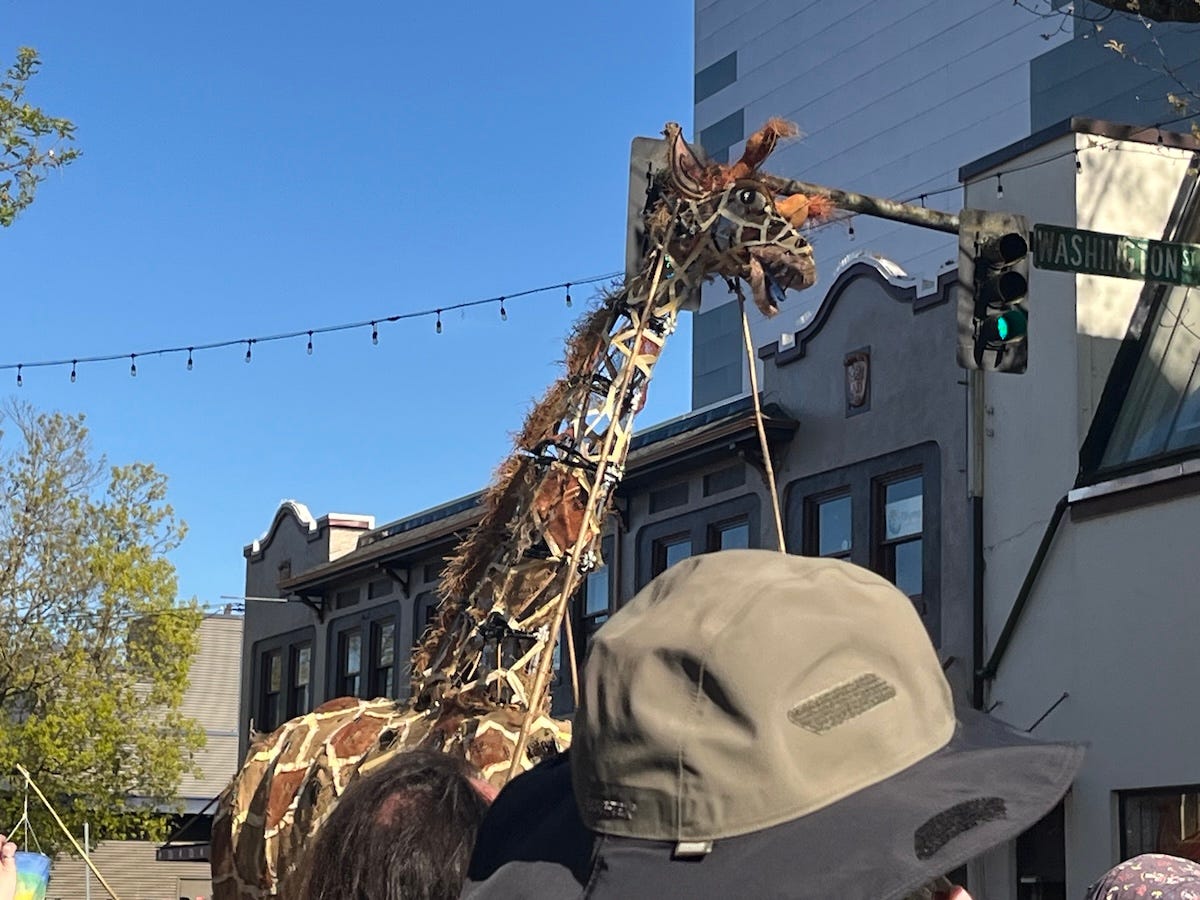
Late yesterday afternoon I walked downtown to watch the “Procession of the Species,” an annual parade in Olympia that closes out the spring Arts Walk weekend. The parade had just started when I got there. There were thousands of people lining the sidewalks three or four deep as far as I could see along its route. The procession centers around maybe two dozen super-sized animals, like that giraffe up-top, 20 feet tall, utterly enchanting. There were huge groups of dancers, drummers, musicians, hundreds of other adults and kids holding up images of animals, insects, plants, an almost endless stream of joyful, reckless, emotional and physical abandon. Crammed as I was at the back of the crowd, barely able to see it all, I still couldn’t stop laughing. It was “indescribably delicious,” as that old slogan for the Mounds Bar proclaimed. Yes, most people preferred the Almond Joy, milk chocolate, an almond on each half, very nice. But the dark chocolate on the Mounds, so slightly-wavy-sleek, like William Powell’s hair in his “Thin Man” years, Myrna Loy wisecracking back at him, that, to me, was indescribably delicious.
Olympia has an assortment of other annual events of this sort that are equally astonishing, like the Gay Pride Parade, many, many hundreds of mostly young people, gay, lesbian, trans, bi, queer, straight, dressed extravagantly, carrying signs and banners, marching, dancing, shouting their way down Capital Way; the crowd, many, many additional hundreds, answering in kind, like a massive duet celebrating not difference but tolerance, love, even. Or the Pet Parade, as playfully weird as it sounds, all kinds of animals and their people costumed in whatever—tutus, pirate outfits, bird masks, whatever—their pets on leashes, in baskets, on carts, in wheelbarrows. You name it, you’ll see it. And my reaction is always the same: I can’t stop laughing.
I have known since I was a kid that my brain produces an excess of some chemical that, when it gets activated, makes what I experience look and feel mildly psychedelic. It is one, among many, of the blessings nature has gifted me with. I know I give off a vibe of aloofness, that I often describe myself as “reclusive,” and that I am, literally, afflicted by a clinical-level “social anxiety disorder” of epic proportions. That does not mean I don’t like people. I tend to prefer huge exuberant crowds like the one I joined yesterday, merging with them, forgetting my/self in the mayhem. I was in a dark bar in the Pittsburgh one night about 50 years ago, on a date, listening to some rowdy band. All of the sudden the room erupted in a fight of inexplicable origins, fists flying, tables upturned. My date was paralyzed with fear. I was paralyzed with amazement, just sat there calmly, feeling cocooned in safety, witnessing the spectacle. When it was all over, we got up and left, our table one of the few still standing. One of the best dates I ever had. She never went out with me again. Unfortunately. I really liked her.
I am also very comfortable around marginalized people, like the homeless I walk through and among on my early morning walks. Maybe because I look like one of their own—an older, slight, bearded man in jeans with a crooked, puzzled-looking half-smile on my face—they seem at ease in my company. In the “normal” vein, I excel at one-to-one conversations, across a table, in a living room. Put me in a group or at a party, and I flail. Or fail. When I tell others how rarely I actually see the people who are most important to me, they think I must be sad, missing them. I tell them, over and over, that the people I love are with me, vividly, fully alive, all the time, whether they are physically present or not. They make me happy, all the time, whether they are physically present or not. Maybe it’s those chemicals doing what they do. So, while I may be solitary, I am never, ever, lonely. Except, sometimes, with people who simply can’t see me. When I have to spend time in such company, which is not uncommon in a culture like ours, in my head I leave, go to a parade, take a walk in the woods, or, best of all, carry on a conversation with one of my kids. Since I’m pretty good at impersonating myself on auto-pilot, no one ever seems to notice that I’ve gone.
The day before yesterday I walked downtown to see the much quieter first evening of the Arts Walk. Olympia is the smallest town I’ve lived in since I left my hometown 60 years ago. It is full of little shops and eateries, most of them charmingly eccentric, like something out of the 60s. Not a big box or chain restaurant anywhere. On the opening night of Arts Walk, many of them stay open late, hosting art works of all kinds made by local creators. You can wander in, look at what’s there, exchange a comment with whoever made it, buy something you like. It is magical. Every year, the main thing I pay attention to is the overall “vibe” of the art. For some reason, I take what I see as symptomatic of the general vibe in the culture at large. This year, what I saw, over and over, in multiple media and materials, was brilliant splashes of primary colors colliding cacophonously in a “style” I’d call some combination of psychedelic and primitive. So playful, joyous—insects, animals, people or just various shapes intersecting, interacting, in the most amusing and alluring ways. I took from this the general sense that those who have a vision for what’s up ahead, who are filling that space with their imaginings, are so over the exhausting dystopic drama that our political and journalistic culture seems to want to keep us riveted toward. “Flooding the field” works for a while. But soon enough, which is now, everyone is so accustomed to the fake spectacle of it that it feels utterly predictable, boring, inane. The reality you prefer, from that vantage point, is a “Procession of the Species,” not some lame or demented press briefing delivered from an airplane doorway by a bag of fat who has ceased to be able to speak, let alone think.
All of which is to say that I have not, like Li Po in his elder years, “left the peopled world forever.” By the same token, I have said, with intention, a number of times over the last decade or so, that I needed to retreat from some social context or another in order to “heal.” I was never quite sure what I meant by that, and I’m guessing whomever I said it to felt likewise, figured I’d be gone maybe a couple of weeks, then back, hunky dory, “fixed.” Each of those interims ended up taking many months. I read voraciously, wrote obsessively, learned (or wrote) and recorded songs, walked and walked and walked some more. Which is what I’m doing now.
“Fixed” is for broken. I’m pretty good at fixing things. The first thing you have to decide about something broken is whether there is a fix that will restore its functionality. If so, you do it and it’s done. If not, you chuck it. My wife’s death did not leave me broken. It left me wounded. Wounds have to heal, a process with no deadline or endpoint. It takes the time it takes. You tend to it and tend to it and one day you look down, see that thin, white scar and figure you can move on. Then one day something opens it again and you start over, not from zero but from where you are, with all you’ve come to know about what it takes to heal. About a month ago, the wound re-opened, so I am off again, healing.
All of that discourse is, of course, figurative. A wound of this sort is invisible, no broken skin, no blood. Nothing, really. You can ignore it if you want, show up as your “old” self almost immediately, which is what I did at first. Two things I learned very quickly about all of that were: (1) Just because neither you nor anyone else can see the wound doesn’t mean it isn’t there; and (2) if you don’t find a way to heal it, you will end up broken in a way that can’t be fixed. That’s the there-but-not-thereness Derrida names sous rature, under erasure. Your name with a line drawn through it. And you can’t get rid of that line without removing a lot of the name it crossed out. So you have a choice: vacuity with a side of anger, or rewriting your name.
Farrow says grief and rage are savage companions. They are, to be sure, a fearsome duo. And yes, repression and impersonation can work pretty well to keep them at bay over the short run, the pretense that you are who you were and life goes on. Hunky dory. But there’s that third thing she throws in: despair, way more scary than the other two, which you sense can set in at any time if you’re not careful. And I don’t just mean the weeping and gnashing kind. Despair can wear a smile, too. Until, every now and then, if someone is paying close enough attention, for a microsecond, it droops into a blank stare, and you both know there is no one there.
I’ll tell you what I think right now, today: The main remedy for healing is love. I mean real love, the right kind of love. The kind every wisdom tradition I know of places at the center of its vision, even if it doesn’t call it that. I’ve written in this series about “the hard problem” of consciousness. Today I’m thinking about “the hard problem” of love, how easy it is to assume that it’s being given and received when it’s not, felt and shared, when it’s not. The hard problem of consciousness softens immediately once you conclude that it is and always has been already there, that you simply inhabit and share it. At once, it becomes soothing, safe, peaceful. Love may well be likewise. If I’m reading the tortured prose of C.S. Pierce right, in his essay “Evolutionary Love,” then love is the arc of our universe hoping not just to see itself—which is what consciousness can do and is for—but to cherish itself. Love itself. Truly. The right kind of love.
In other words, love is also always already there, has been from the outset, a field that saturates everything everywhere. It is something you inhabit and share, not parcel out and feel. Whether you do that well or poorly is not the issue. The former is not something to praise any more than the latter is something to fault. When a human being is being fully human, whether for years or days or minutes, they know what love is and how to proffer it freely. And when another human being is being fully human, they know how to welcome it gladly. You, me, anyone, we can’t do any better than our best in that regard with what we have and know at the moment. Love is not a wad of cash you wait around to dole out grudgingly or grab greedily; it’s a state of mind you decide to create and stay in as long as possible. Jesus calls it the Kingdom, Lao Tzu calls it Way, the Buddha calls it Nirvana. The foundation for that, they all say, is making sure your in-here and that out-there are keeping the peace with one another. And they all also say, in one way or another, that the first step, the one you absolutely cannot skip, is loving yourself, truly, the right kind of love.
Like most people I spent chunks of my life waiting with the hope, if not an expectation, that I’d be loved for “who I am,” as if that recognition was out there somewhere. I know now that this “who I am” is exactly what love actually is. Always and already. The “I am who I am” that the universe we inhabit, which is innately godly, tells me every second of every day “I am” one with. From that vantage point there is nothing left to wait for. Being loved, being “understood,” those are things you can and should be doing for yourself right now. As I said at the end of a long poem I wrote a few years ago:
always
and I mean always
in the lush hidden chambers
of your own heart
where you speak to yourself
ceaselessly
say I love you
over and over
an endless loop
as if those are
the only three words
you still remember
will ever need
to hear orthink
So where am I now with this rage/grief thing? Dylan Thomas wrote a beautiful and (to me at least) enigmatic poem, applicable to this, called “Do not go gentle into that good night.” You may know it. The poem is a plea to his dying father, rendered in the final stanza, to “rage against the dying of the light.” I said enigmatic because it is unclear to me whether Thomas wants that for his father’s sake or his own. In the previous stanzas, the simplest reading is that all the other “men” he mentions, introduced as the “wise,” the “good,” the “wild,” the “grave,” had done just that. Raged. Fought back. He wants his father to do the same, and he’s not. But it is also possible to read the final lines in each of those previous stanzas as a frantic command from the poet himself, full of his own rage at what he stands to lose, to all these wise, good, wild and grave men, who, like his father, simply gave in, not only ready but eager to move on.
It’s very hard for the one who lives on after a traumatic death. You wish the one who left had raged harder “against the dying of the light,” had fought back, hung on, simply survived. So you take on that rage, those “fierce tears” that Thomas complains weren’t there, as if you’re doing it on their behalf. It may be the most essential thing for you to do, in order to hang on to some faint hope that what Thomas calls your “frail deeds” might somehow learn to “dance in a green bay.” What that fails to account for, though, is that “at close of day” it may have become suddenly and absolutely clear to all those “men,” to Thomas’ father, and to Carol, too, how impertinent and useless that rage is. It belongs down here. And that’s where they wanted to leave it. I can and will covet and care for mine, that “cool-blue to yellow-hot” flame, for as long as I can. For myself, whom I love, for the others I love and who love me, and the many others I inevitably if unintendingly singe in the process. That is what staying alive requires. And when the time comes, I hope I will simply “go gentle into that good night.” Not because it is time, but because it is good.
Buddy Holly wrote “True Love Ways” as a wedding gift for his wife, Maria Elena, in October, 1958. Just a few months later, in February 1959, the little plane he was on went down in a snowstorm in cornfield in Iowa, what became “the day the music died.” He was 22. About 6 years ago I recorded an album, singing covers of my favorite Buddy Holly songs. I listen to it every day. Maybe there’s a French term for that, too, meaning doing something loony to keep from going crazy, a form of un-erasure. When you seek wisdom, you often find it in the most unexpected places. Buddy Holly was such a sweet, brash presence in this world. I was enamored by his music from the first time I heard it coming from the little black transistor radio I got for my birthday when I was 10, the month he died. His death was heartbreaking to me. His music still inspires me to be more alive. Had he lived a full life, I like to think his wisdom would have multiplied exponentially. In lieu of that, I bring him back to life every day. And when I do, he brings Carol back with him. Those “true love ways” and all that “raining in my heart.”
That poem I wrote this morning, inspired by those extravagant lilacs and a couple of Walt Whitman’s most extravagant poems, breath and death shaking hands companionably in every line, is gorgeous. Sometimes I can’t believe I can make such beautiful things. Then I remember what I really know. They are not mine, never were. I simply receive them, the way a radio receives its music, as gifts, blessings, from a loving universe. Which I’m sure Buddy Holly knew as he made those magical songs. And Walt Whitman, too, unendingly loquacious, who says this about what he finds in his path:
. . . I guess it is the handkerchief of the Lord,
A scented gift and remembrancer designedly dropt,
Bearing the owner’s name someway in the corners, that we may see and remark, and say Whose?
Whose, indeed? In Romans 8:28 Paul says: “All things work together for the good,” a passage usually taken to mean that things will work out hunky dory for you, if you just have enough faith, the one thing Paul says you better have, or else. Today what I hear it saying is this: We live in a universe that is “designedly” working toward the good. Always. Together, all things, one. Just because things didn’t turn out so well for Carol, or me, doesn’t mean they aren’t for the good. That’s the faith-buster right there, if you let it be, the rage-maker. In Philippians 4:7 Paul says there is a “peace” which “surpasses all understanding,” one “that will guard your hearts and minds.” I have spent so much of my life and energy trying to keep the peace, assuming I understood what that was. It undermined mine, fomenting rage, and was, in the end, utterly pointless. All I want now is to keep the peace in my own spirit, to guard my heart and mind in that place where understanding is surpassingly abundant. I don’t want to need, hope, or expect to get it from any other place but that. I’m not quite there yet, but I swear I see it, dancing like the Northern Lights through all this darkness. I truly believe that when I get there I will be healed. And I’ll meet Buddy Holly, his “love . . . big as a Cadillac,” and Walt Whitman, “sounding [his] barbaric yawp over the roof the world,” and everyone else I ever loved, and everyone who ever loved me enough to leave their initialed, scented handkerchief for me to find, and took the time to pick up mine, Dewitt and Parmenides sitting perfectly still there, waiting for me, maybe humming the same beautiful note eternally, a music that doesn’t need time to be made or heard, inviting me to add my voice. That would be heaven. Yes, that would be heaven.