
Lilacs

All I need is a little sun,
Some for me, some for everyone.
Jack Johnson (from “Little Bit of Love”)
The weather turned here yesterday, the first genuinely summery day, 70 degrees, bright sun, perfect. The weather in my head turned with it, blue skies as far as my eye can see, enough sun for me and for everyone. This series, except for the Bunny Lang piece, has been pretty gloomy, I know, like winter here. Olympia is the farthest north I’ve ever lived and December-April is the rainy season. So it’s short, gray days, long, dank nights. A slog. My head tends to follow that lead, especially February-April, so impatient for it to be over. Summer is the exact opposite, and it’s here now.
I get a smattering of responses to these posts. Figuring out what they say about either the quality or propriety of what I write is like reading tea leaves: very little to go on, big implications. One factor I include in my “tea leaf reading” equation is silence. Buddy Holly’s band was “The Crickets,” named after the actual crickets they heard, practicing in his garage in Texas during their formative years. We use that term now to name the almost comical absence of any meaningful sound: Crickets!
In this series I wrote a number of posts about my intermittent struggles with grief. The feedback was crickets, which suggest that you’d prefer less of that and more of the other stuff I write about here. Point taken. One other message silence sometimes conveys is concern, about one’s wellbeing, say, a topic as walking-on-eggsy in our culture (unless you pick up a gun and kill someone) as death is (unless someone kills you with a gun.)
Here’s what I have to say about all of that: First of all, I’m good. Or is it well? Well, it’s both, and fine, as well. Truly happy, even! I have an extraordinarily high tolerance for the dark, know I have to go there from time to time to find my light. I don’t welcome it any more than I welcome winter. But I don’t shirk it either. Here are a couple of stanzas from a poem I wrote back in 2016, after a walk in Boyce Park, pertinent to this, called “This Dark is Mine”:
At the top of the hill
where I always first feel
what today I decided to call
a holiness in this place,
the tall, lean poplar
on my right, speaking
for all the trees,
their collaborative voice,
said: Take care now,
Paul, this dark is yours.
Show no fear.
It was always there
waiting for you, the way
from where you are
to where you go.
Take heart from us.
We will meet you here
every morning, cheer you,
the September daylight
so bright, so clear,
this light we love and use.
But we are specialists
of the dark, know all
its ways. Remember,
so are you, so do you.
When the dark stands between where I am and where I need to get, as it did this month, I go through it. Perhaps I shouldn’t have taken you with me on that walk. That dark is mine, not yours. In my own (feeble) defense: I use writing not only to tease out relationships among the many diverse and seemingly unrelated things that intrigue me out-there, but also among the many diverse and seemingly unrelated things that intrigue me in-here. If I don’t write about them, they never get settled, and I want them settled. And, of course, you can stop reading any time you want. This is not the SATs.
One of the things it’s easy to forget if you are both neurodivergent and ultra-sensitive, which I am, is that the emotional scale you’re operating on is different from the norm. Over and over in conversations with others about volatile matters, they will say at some point “I hope this isn’t too upsetting,” in all the various ways that “upset” can apply in such conversations. I am always stunned. I tell them what they’re talking about doesn’t even move the needle on my upset-meter. That is one of the counterintuitive side-effects of ultra-sensitivity. You’re always redlining the tach. When you have to slow down, it’s like what a Formula One driver must feel inching through a school zone: “Am I even moving?” It is, clearly, a mistake to assume that such an eccentric scale is commonly shared, let alone universal. My apologies if these missives felt impertinent, even intrusive, like “shut the hell up already, Paul, and just deal with it!” I’ll be considerably more mindful about that going forward.
That said, this series is over. I enjoyed writing these pieces, learned so much from them, and changed in quite significant way because of them, which is my primary mission these days. Healing and changing are not, obviously, exactly the same. But, in my opinion, you’ll never do much the former without doing a lot of the latter. In any case, now “it’s summertime, and the livin’ is easy.” For me that means even easier than my usual easy!
Summer here is idyllic, opulent greenery, wall to wall blue skies, and I intend to savor every minute of it. So I’m taking it off, starting today. Like me, I hope, as that great song goes on to say, “one of these mornings you [too] will rise us singing, spread your wings, and take to the sky.” One of the things I’ll decide in the interim is if I want to come back to this venue with whatever is next and new for me. If I do, you’ll get your usual link. If not, I hope not only that your summertime livin’ will be easy, but also, in the spirit of what Coleridge says in “Frost at Midnight,” that:
. . . all seasons shall be sweet to thee,
Whether the summer clothe the general earth
With greenness, or the redbreast sit and sing
Betwixt the tufts of snow on the bare branch
Of mossy apple-tree, while the nigh thatch
Smokes in the sun-thaw; whether the eave-drops fall
Heard only in the trances of the blast,
Or if the secret ministry of frost
Shall hang them up in silent icicles,
Quietly shining to the quiet Moon.
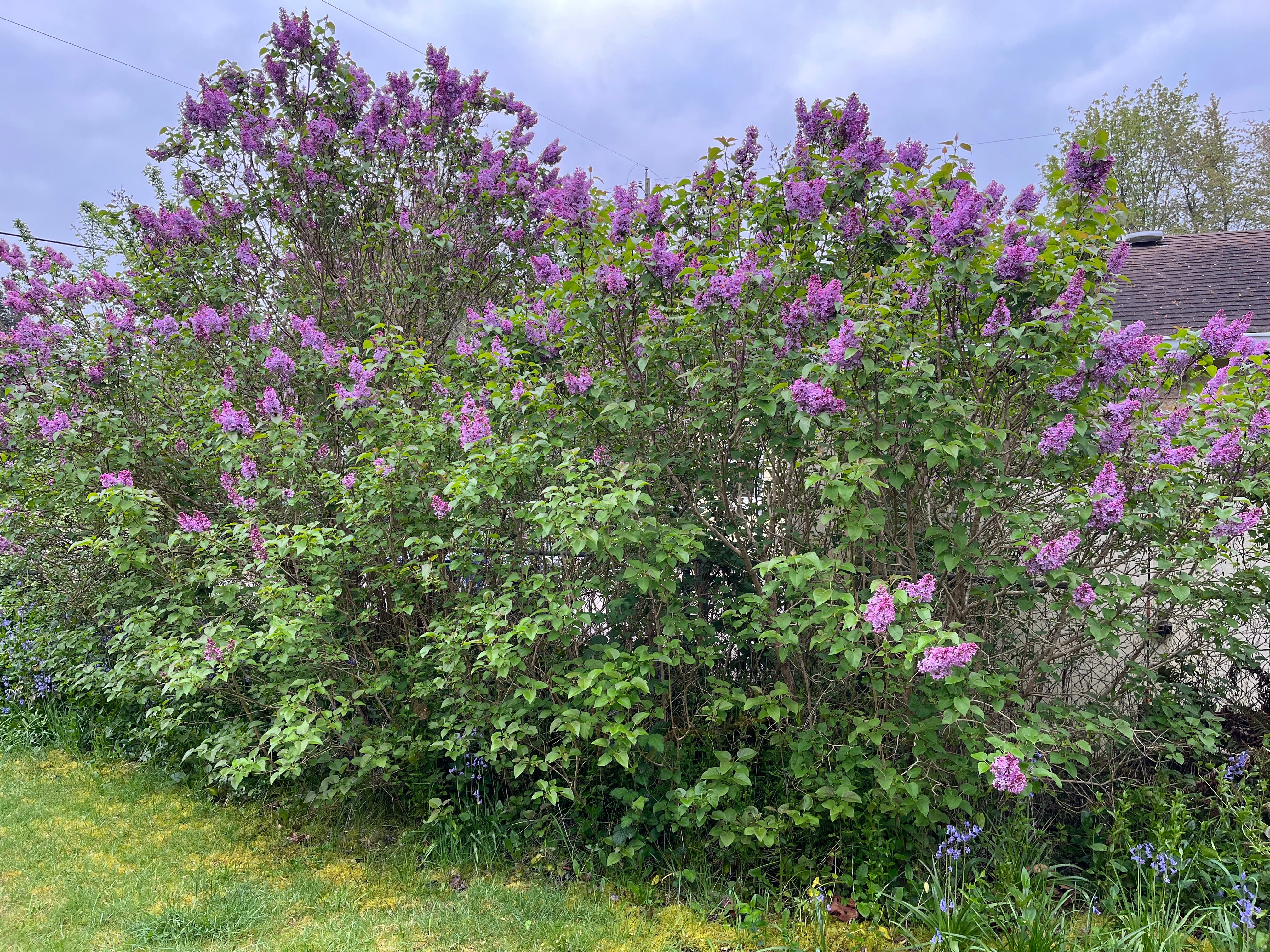
I think I’ll close this all out with the poem I mentioned last time, the one I wrote the other day for my Instagram, just because I like it. It’s called “coming home.” The quoted passages are from Walt Whitman’s “Song of Myself,” a paean to his own enormous spirit, and “When Lilacs Last in the Dooryard Bloomed,” his doleful elegy for Abraham Lincoln. The image I used (up top here) is a photo of some of the lilac trees in my back yard that inspired the poem, far and away their most florid display since I got here 8 years ago. I take that as a sign of good things to come:
if you were walking with me just now
past these lavish lilacs in my dooryard
more pink than purple this year
and heard in the back of your mind
“I breathe the fragrance myself and know it and like itthe distillation would intoxicate me also but I shall not let it”
and a few seconds later remembered
“when lilacs last in the dooryard bloom’dand the great star early droop’d in the western sky”
you would know everything I know about
“the play of shine and shade on the trees as the supple boughs wag”
and the
“moody tearful night lilac and star and bird twined with the chant of my soul”
without even one word passing between usand that no machine could ever begin to fathom
how we knew what we know no matter how hard
we tried to explain how one mind can move
from breath to death and back again
before I finish turning the key to unlock the back door