
Misunderstanding . . .

And now for something completely different . . .
Monty Python
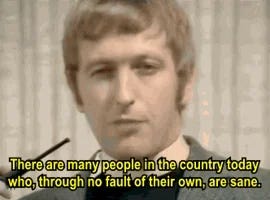
My three month sabbatical of “indolence” came to an end a couple of weeks ago, right on schedule. During that interim I recorded three new albums, mostly covers, which is about my usual production during my “off” months. I enjoyed every self-expressive minute of it and now feel once again “energized.” In other words, I’ve started to write again. Much of it, as is always the case at the outset of a project, is still inchoate, many snippets in medius res. I do have an overriding theme I want to explore, which I’ll introduce today; and I have some ideas about how I want to illustrate and explore it. What eventuates from this work may or may not be ideally-suited for the Substack format: relatively self-contained “essays” in the 5-7 typed-pages range. Depending on how my writing goes, I may post all or just some of it here. In any case, I’ll start with this and see where it goes.
…
A thought went up my mind to-day
That I have had before,
But did not finish, -- some way back,
I could not fix the yearEmily Dickinson
At some point in the middle-third of my career in the English Department at Pitt—as Emily Dickinson says, “I could not fix the year”—the faculty in my home program, which had always been called the Composition Program, decided it was time to add the term “rhetoric” to its title, all the rage back then. We convened a meeting, which included three recent hires, all of whom felt rhetoric should have primacy. At the get-go, one of them made a strong case for this. After a bit of generally consensual discussion, I intervened with what I considered to be an innocuous gesture, simply to say that my own investment was primarily in pedagogy, for which entry-level instruction was a crucial site of practice. Historically, those courses were generally called “composition” courses, so I felt an allegiance to that term. Nothing to see there. Just a statement, not an argument. The person who initiated the conversation, though, took this not simply as a challenge but as a personal critique, neither of which were remotely on my radar, and responded aggressively and dismissively. Most of the others seemed to endorse that response. I knew right then that my position was anathemized and, more importantly to me, my relationship with this colleague was permanently and irretrievably broken. I could have done many things in that moment, but I chose simply to go quiet, which I’m quite good at, not just in that contestatory exchange but in the extended conversation that followed.
I’ve written a lot over the last few years about an assortment of Christian heretical texts and will have more to say about one of them in particular in this series, the “lost” Gospel of Mary of Magdala. Whether it is two millennia ago or two minutes ago, I know that once one’s position gets branded as heretical by the powers that be—as mine was not only that day but more broadly in my discipline, which was making this move to a rhetoric-centered identity everywhere, more reflexively than mindfully, I thought—there is no good exit strategy. Best just to keep your inner peace and, if possible, find a different audience to speak with.
In any case, “a thought went up my mind to-day/ That I have had before” and I want to pursue it further. Right around the time I finished my “In the Spirit” series I became preoccupied again with the problem at the root of moments like that one: misunderstanding. I, like every human who ever lived, know all about what that is experientially. My interest in it conceptually was piqued about 50 years ago when I first read I. A. Richards’ The Philosophy of Rhetoric, based on a series of lectures he gave on a visit to Bryn Mawr college in 1936. I was interested back then in thinking about the proper province of the “field” to which I was about to dedicate my professional energies. I read a lot of other texts that address this matter, most meaningfully to me the Platonic dialogues in which Socrates engages contentiously with the “sophists” (itinerant teachers whose programs were kind of like “finishing academies” on steroids for wealthy young men, the Harvard Business Schools of the day) in his intellectual community, figures like Lysias (the object of inquiry in the Phaedrus), Gorgias (a formidable contestant with a dedicated posse of followers); Meno (a wealthy young protege of Gorgias whom Socrates engages in a particularly acrimonious debate), and especially Protagoras, a “star” in this “field.” The theme of all these arguments is virtue, and the pertinence, if any, of rhetorical instruction in promoting it. That term—virtue—may seem quaint, even antique in our current parlance, set aside usually to talk blandly about matters of religious decorum or female sexuality, the saintly or the dainty. But for all of these contestants (and for Plato who ventriloquizes them) the matter at hand is much more general and urgent, pertaining to “the good” in ethical, even moral, terms, right up my alley. In every case, Socrates is skeptical that “rhetoric” (at least of the sophistic variety) can be a foundational discipline toward that end, most famously in his argument with Protagoras which starts with his seemingly innocuous question: What is the field of rhetoric? and ends with his dismantling it as a vacuous pseudo-discipline.
2400 years later Richards clearly believes otherwise, asserting confidently that “rhetoric . . . should be a study of misunderstanding and its remedies,” the sentence that will hover over, around or behind everything I’ll be writing in this series. Fair enough, I thought when I first read it. But gradually over the years, as I learned more and more not just about my field but about the academy—its values and the professoriate who enact them—and then both recollected (from as far back as I could remember) and reflected on my personal and professional experiences, I came to believe what I have said quietly in my head many times over the years, responding directly to Richards: “Sorry, Ivor, but there is no remedy for misunderstanding. The best thing to do is avoid it, which is no mean task in the human universe. There are ways to avert misunderstanding ahead of time, but to believe you can cancel its effects in the aftermath—i.e., return to the state of accord before it happened—is delusional.” That leaves a rhetorician in a real pickle. What’s the point of any of it if it’s ultimately ineffectual at its most important function? I’ve been thinking this through, as I said, in stages, for some time, and what will follow here in the coming weeks is some of what I now have to say about all that.
Last July, as I was finishing up my “In the Spirit” essays, I went through a dramatic personal upheaval, a transformation in my spirit that I had been working assiduously toward pretty much forever, but quite dedicatedly so since I retired seven years. I presume all those pieces I was writing about various “wisdom” texts and traditions helped to precipitate it, which indexes the value of persistent work in promoting growthful change. I was sitting on the couch in my living room one afternoon nothing-doing, as Laozi would say, and suddenly the inside of my head felt like it popped up through the top surface of its big bubble and puffed out into a much smaller bubble that I thought, over time, might expand, not replacing the one that spawned it, but adding a new dimension to it, a quantum leap of consciousness, if you will. In that moment, I thought, hey, maybe I had become enlightened, my work done. I know now that was inanely hubristic. Both “I” and my experience of the world are different, in quite salutary ways. I feel calm and peaceful most of the time no matter the circumstances. I have ceased exerting any inordinate energy to amplify my “social network,” which I felt was compulsory when I arrived alone in Olympia 7 years ago, a process that did not go well. Now it is better. And I laugh a lot more than I did, often for no apparent reason. The motto I concocted to describe this state of mind was “I don’t want anything I don’t have and don’t have anything I don’t want.” A sentence I like from the Tao Te Ching that says essentially the same thing has been translated variously as, for example, “He who knows that enough is enough will always have enough,” or my preferred version: “When you realize there is nothing lacking, the world settles by itself.” And a settled internal world in a world as profoundly unsettled as ours right now is a great blessing.
I have always savored solitude. Now I can’t imagine a better way to spend my time. I could go on and on about the ways that metamorphic moment changed my way of being in the world. But I am certain I am not enlightened. Just happier being who I am. Where I am. Right now. Nothing-doing what I’m doing, whatever it is, in the moment. In retrospect, ironically, one of the things that precipitated this change was a series of perceived misunderstandings, none of which I could rectify despite my best efforts. I finally just conceded, to myself, that being “understood” in the human universe was not generally in the cards for me. And, honestly, I think it’s rarely in the cards for anyone, at least at the deepest level. But it is, I concluded, possible both to minimize misunderstanding as a chronic state in relationships and even to approach something akin to understanding asymptotically—in that you never get there but come closer and closer, like infinity in certain graphed math equations. It just takes a lot of work to do that, maybe the most important work anyone can do to promote personal and communal happiness, even peace, in the world in front of them or the world at large. I’m pretty sure that’s when I decided to write this series, which I’m imagining now as a compendium of commentaries, strategies and techniques to at least become conscious of, perhaps even liberate oneself from, some of the natural tendencies that cause misunderstanding.
Which gets me back to that quote from Richards: “Rhetoric . . . should be a study of misunderstanding and its remedies.” Though it is not an express feature of his talks, the rise of fascism in Europe is clearly on his mind, evident in the underlying angst that seems always to be agitating his thinking. While he may be talking about more commonplace misunderstandings, the big one, that shadow of impending doom in Europe, haunts them all. Obviously, he believes that rhetoric can serve a remedial function in situations of both sorts. I have always been skeptical of that. The immediate thought that crossed my mind in the meeting I describe above was: “There is no remedy for this misunderstanding.” It felt so instantly intractable that no amount of “talking” was ever going to lead to recovery. Which is why I went quiet. The question I began to ponder back then was whether there are in fact tractable misunderstandings, even if that one wasn’t. My current answer, based on experience and evidence is: “No, not really.” At least not solely and specifically via “rhetoric,” whose function, if it has any at all in matters of that sort, should not be remedial but prophylactic.
That is especially so in relatively new relationships, which often collapse under the strain of such disruptions. Anyone who has dated to meet a potential partner knows all about that. One little conversational glitch occurs early on, often provoked simply by anxiety, and it’s over. For more well-established relationships, like within families or marriages, where the stakes are exponentially greater, misunderstandings can be mitigated over time, but their effect is never null, in the same way that wounds leave scars even after they have healed. So: Try not to misunderstand! Which is way easier said than done, of course, given that the “said” part relies on language, the primary instrument of “rhetoric,” which is (in my view and in the view of all those sages I wrote about last summer) a very weak medium for “understanding” anything of magnitude. Richards already suspected this, I assume, having spent years working with his colleague C.K. Ogden to concoct something they called Basic English, a lexicon of about 800 words that could be arranged together via a limited set of syntactical structures to assure clearer communication. My guess is he hoped a resource of this sort would be sufficient to remedy the misunderstandings that were threatening to tear Europe asunder. Not only didn’t that work, anyone with an ounce of intuition about human nature and its love affair with the confabulatory capacity of language understands that it can’t. Pretty much ever. Which is to say, again, the best remedy for misunderstanding is not to fall prey to it. That’s what I want to write about in the series of essays that will follow here.
I’ll begin with a working hypothesis: “Understanding,” at least in its most fulsome, finished form, is a myth. And not one of the good ones, because it is so easy to presume it’s there when it’s not, which not only creates problems that can’t be solved, but can make it seem those problems are not there in the first place, or, after attempted interventions, there any longer. The worst of both worlds. Nor is language/rhetoric adequate on its own to “remedy” misunderstanding, since it is one of the primary causes of it. But I do believe there are things human beings can do to make the latter less likely and the former at least aspirational.
Because misunderstanding has been on my radar for such a long time, I’ve written about it a number of times. In The New Not-Normal, for example, I document what it feels like to live as a neurodivergent in a sea of neurotypicals. Spoiler alert: misunderstood! And I wrote about it more generically in In Dreams, where I proposed “not-understanding” as a means to avert misunderstanding by keeping one’s stake in any ongoing conversation or relationship always open-ended, in play. I argued that since our universe is defined and regulated by time, we and Nature, by our very natures, are captive to eternal changefulness. Any presumed understanding is, by definition then, by dint of its implied finality, a misunderstanding within moments of its occurrence. Now, these several years later, having immersed myself in wisdom traditions, including quantum mechanics, I want to revise that term to “un-understanding,” which suggests that avoiding misunderstandings requires not just a static resistance to closure, but an ongoing dismantling of the finalized states of mind that promote closure in the first place. The difference is this: Not-understanding is passively passive, un-understanding is actively passive, which sounds pretty obtuse, I know. I have a piece in the works where I work out in more detail how I differentiate those two modes of passivity, beginning with what William Wordsworth calls “wise passiveness” in his famous poem “Expostulation and Reply,” which you may remember from my August 15th post. I wouldn’t necessarily say the former is “dumb passiveness.” But a distinction of that sort suggests the magnitude of the difference I have in mind. Or you can think about it in terms of the common political stance of “passive resistance,” which is decidedly different from simple passivity in that it requires intentional non-action and a deep commitment to the possibility of change, even as it strives to do nothing in the face of force.
One of the wonderful after-effects of reading wisdom texts, including quantum mechanics, is the buzzy afterglow that suggests what they “mean” is always right up ahead, just out of reach, tantalizingly elusive, teasing further inquiry. You want to keep returning to them, not with a conviction that you will “figure them out” once and for all, but with the faith that un-figuring them out is actually the point. In my “In the Spirit” series I wrote about some of the things Jesus and Laotzi and the Buddha and the Indian Vedas and Werner Heisenberg and Edwin Schrödinger, and many, many poets have said/written. None of them proffers the possibility of “one and done” interpretive event. Initially, they are in fact quite baffling, like an Emily Dickinson poem: You don’t “get” it immediately. So you either conclude it is un-gettable and walk away (i.e., misunderstand it as kind of impenetrable nonsense); or you come back once or twice and presume you do get it (another mode of misunderstanding); or you keep coming back with the openness of un-understanding, not just resisting the temptation to finish the getting, but actively dismantling each previous getting to allow the next one to come into being.
That is the difference between acquiring wisdom and memorizing information. The latter is one and done. The former both aspires to become one and is never done. We are, especially in the West, afflicted by a belief that our primary modes of reception—reading and listening—should lead very quickly to finalized states of “knowing.” When they don’t we assume the problem is out there, not in here. Even quantum mechanics, as “hard” a scientific system as you can imagine, says finally that irresolution (literally an always-slightly-out-focus state of being), what Werner Heisenberg called “uncertainty,” is built into the very fabric of our universe at the deepest level. Certainty, as in absolute precision, the rock-solid promise of Newtonian mechanics, is precluded. Simple as that. All the worthy gurus and poets I know of presume the same thing. The goal is not to reach “stop,” or even to forge ahead, but to keep circling up and around, like the falcon in Yeats’ great poem “The Second Coming,” “[t]urning and turning in the widening gyre.” What happens in that gyre sounds pretty scary in the poem: “Things fall apart; the centre cannot hold/ Mere anarchy is loosed upon the world.” That’s stanza one. Stanza two opens this way: “Surely some revelation is at hand.” Much better. The one he’s envisioning as he writes this in the aftermath of WWI, the old order in rubble, looks to him like a “rough beast.” But its time has come because “Twenty centuries of stony sleep/ Were vexed to nightmare by a rocking cradle.” Waking up from an addiction to familiarity and fixity always feels at first like a rough beast. But once you get a taste for the ongoing revelations it proffers, you will never want to retreat to such a “stony sleep” again. Sages know this. Their theres are never quite there. And when you circle up and around them long enough, the gyre widening, you find that their theres are there everywhere. Once you accede to that truth, our worlds, from the tiniest particle/waves, to a simple conversation, to the most complex social and intellectual systems become, in their mystery, not frustratingly evasive, but beautifully elusive, worthy of chronic and recursive re-readings. The un-understanding process I have in mind is kind of like that.
I say in In Dreams that what I call “not-understanding” is
a liminal state in which meaning-making has no final destination or endpoint, no place to put a period at the end declaring “understood” as the outcome. “Misunderstood” is, after all, just an aberrant form of “understood.” It may be a stretch to suggest that understanding is always to some extent also misunderstanding. But the more I think about that, the more I believe it to be true. What is imperative is continued listening, careful attention, constant adjustment, a lovely (to me) extended process of “coming-to-know.” In short, not-understanding is not only not misunderstanding, it is the very means by which misunderstanding can be avoided. (78-9)
Un-understanding goes further, suggesting that there is no “may be a stretch” to it. It is simply true. And it inverts the previous sentence to say: “‘Understood’ is, after all just an aberrant form of “misunderstood,’” not vice-versa. The moment you presume you understand anyone or anything once and for all, you don’t. That is especially so with rhetorical matters, which is where I and I.A. started (and parted at loggerheads) here. I’ll be exploring some ways to navigate this terrain in the coming weeks. I hope you will join me and find at least some of what I proffer worthwhile. In other words, I hope you will un-understand what I have to say in all the best ways.
Paul, this is marvelous. I couldn't agree more about the value of un-understanding, be it in our relation to the natural world, to a literary text, or to one another. The irony is that our inability to understand anything, even ourselves, "fully," is exactly what incites our curiosity to keep circling, reflecting, wondering. I think this notion is especially important in long-term intimate relationships, where we're tempted to think we know the other person through and through, with nothing left to learn. It's an elementary mistake I've made any number of times, forgetting not only that there's no absolute knowledge of another but also that people change throughout their lives, so whatever you thought you knew will no longer be the same the next year or week or day. Sameness is an illusion, one we find comforting, but ultimately it leads us astray.