
. . . From both sides now

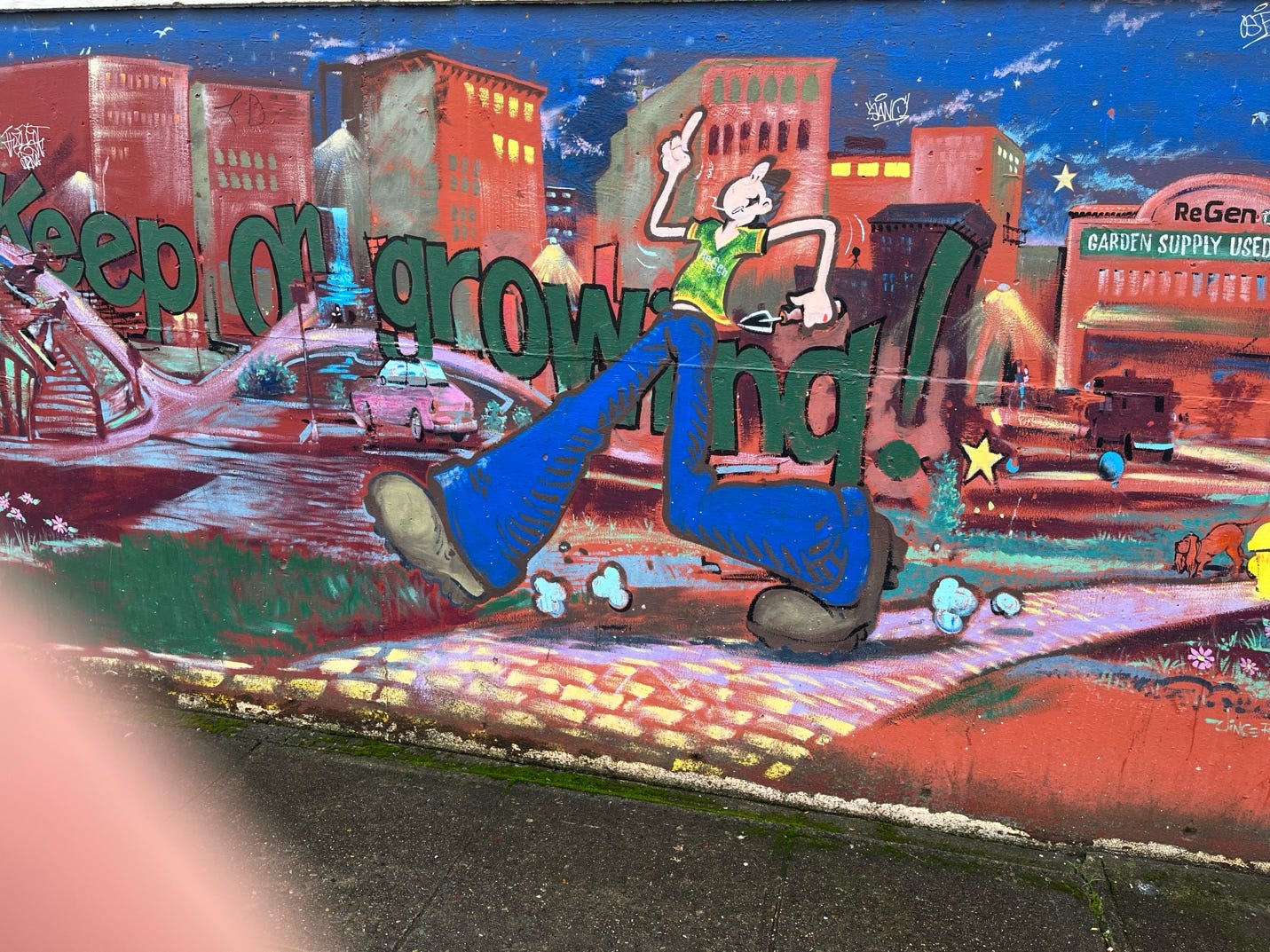
If there’s a blank wall in Olympia, someone paints a mural on it. My favorite is this one, a young Popeye, the yellow brick road, bell bottoms blooming over his chunky shoes, just perfect. When I walked past it for the first time eight years ago I remember thinking: “This is my kind of town. ‘Keep on growing!’ Indeed!” This morning, that wonky shadow on my bedroom ceiling looked like him, a wonderful way to wake up.
All those unpleasant people who had been haunting my dreams? I recently had a series of dreams—same situations, same people—but with exactly the opposite outcomes and effects. They were raucous, full of laughter, redemption, and self-love. In the last dream I had before I woke up today I was taking a course on how to build a new house. The first lesson was assembling a working table saw from scratch. At the end of class, the teacher plugged mine in, it worked great, and I got the go-ahead to start building. So, I guess I have my work cut out for me this fall. A few weeks ago I wrote: “As I sit here typing this sentence, I don’t think I’ve ever been happier. I hope it will last through the rest of them.” It did! I am still happy, not ecstatically, or even obviously to others, just in a calm, settled, everyday sort of way that seems sustainable. Which is, for me at least, pretty much the definition of a miracle. So, my “miraculous season,” the one that opened with Bunny Lang’s amazing poems, did, in fact, have at least one of those, contrary to what I said earlier.
My favorite of John Berryman’s “Dream Songs” is “#28: Snow Line.” It opens this way:
It was wet & white & swift and where I am
we don’t know. It was dark and then
it isn’t.
That’s a pretty succinct description of my last several months, and pretty much every dark to light chapter I’ve written my way through. He ends the poem this way:
If I had to do the whole thing over again
I wouldn’t.
Not me. As I said, I’d do it a hundred times out of a hundred if I had to. Life is good. So am I. So are you. We were born that way, I’m certain of it.
About halfway through his poem Berryman warns:
There may be horribles; it’s hard to tell.
Yes, but there may also be miracles. Like the one I’m writing about right now. I hope it will last through all the sentences I have left in there, tons of them, waiting, hoping, to get written.
There were two words ringing in my ear when I saw that quasi-Popeye striding across my ceiling this morning: “Paul, PA-A-UL,” the second Paul slightly louder and stretched out, with a kind of upturned, questioning lilt at the end. I knew they were from one of the first poems I read, in the late-70s, at Hemingway’s Bar in Pittsburgh, the place to try out new material back then. But I couldn’t remember the title or anything else about it, so I went looking for it on my hard drive. After about 10 minutes of searching, I found it, a poem called “outlines for a letter home.” I wrote it at a time I was trying to come to terms with something I was afraid would leave my mother unduly worried about my wellbeing. I have no idea why I heard that voice this morning, but here’s the poem:
outlines for a letter home
I
there is not much
here to hold
thin stem leaning
into a wind that
will not stop beginning
to resemble nothing
else you can
imagine dash
of shadow penciled
on the snow lengthening
in the light
I live between
these lines next to
nothing all
that you can hold
you call from
the porch--Paul,
Paul--and I want
to answer
II
there was never
much to hold
blue-lipped and
shivering in the lake
while everyone else sunk
in a sweat from the heat
out of a cornfield
wheezing to catch
breath eyes swollen
red and rubbed raw
leaning sullen against
a tree waiting for stars
to fall down and scorch
the bare earth blank
you keep those
photographs in a drawer
to prove that
it always mattered
III
there was not much
here to hold
when wind stood
up out of October
stripped trees
clean with one sweep
when snow swept down
over and over month
after month made threats
and made them stick
and they stood there year
after year and took it
maple beech sycamore ash
quick sketches made to last
all night I heard
you memorizing
their quiet desire
to survive
IV
there is never
much to hold
you call from
the porch--Paul
Paul--and I want
to say right the only
things that matter
I am lean and quick as
forsythia in February
I promise something
lean into the wind
and promise you
live between
these lines next
to nothing all
that I can hold near
enough to hear you
through this wilderness
this wind
“Paul, PA-A-UL,” in exactly the rhythm I remembered it today, was how my mother would beckon my brothers and me back from our neighborhood wanderings at dinner time. I was responsible for herding them home. It’s a poignant memory. While I was searching for that poem, I found a whole trove of others, roughly the same vintage—the 1970s, a pretty dark decade for me, as it was for our culture in general. The poems reflect that. I didn’t think that highly of them at the time, so they got set aside, “lost” really. I was surprised, looking back at them from this vantage point, how much I liked them. They’re good poems. I recovered them into a folder on my desktop and plan to turn them into a book one of these days. So now they’re “found.” About a decade ago, I published a selection of poems I wrote in the 80s and 90s, called it Mornings After. Nice poems, lots of light. I’ve decided to call this one The Nights Before, “the flip side.”
I’ll close out this series by returning to where I started, what it means, or takes, to feel free, a delightful, feather-light, light-saturated state of mind I’ve experienced many times, often for long stretches, since my wife passed. I’ve also experienced its dysfunctional darker side many times, often for long stretches, aimless wandering. One of the metaphors I’ve used to describe that binary state of mind along the way is “off the rails.” Rails, by definition, are already there, and they will take you someplace specific. When you’re on them, you can lean back, look out the window, assume the place you’ve chosen as your destination will in fact be there at the end of the line, may even live up to your expectations, a very enjoyable liminal condition. I was on rails like that when Carol died, on our way to walking every morning on a beach or in the woods somewhere back East. They disappear pretty quickly when the ground gives way. When you’re off them, you are not anywhere you recognize or on your way to anywhere in particular. There is a radical freedom in that, no question, one that, by turns, inspires and paralyzes. I’ve done an equal share of very smart and very stupid things with mine. I try my best to take pride in the former and not punish myself too harshly for the latter. Not everyone has been as generous, which I understand. When you’re on the rails, know where you’re going, someone off them looks chaotic, out of control, kind of dangerous, really. I understand that, too.
When my head is most wayward, I go back and reread This Fall, which always settles me, a beacon of sanity at the center of a void. That’s what I did last spring, which is why I started this series with it. My April was much like the July I described in “Epilogue: Take 1:”
I had a hard July, in my body first, but then in my head, which is more crucial to me now: It was “reality” again, right there, when the next layer down of it starts to work its way up through what you were certain was already rock bottom, becoming faintly visible, not frightening solely in itself, but more by what it hints toward, that there are likely many more such layers deeper and deeper down, waiting for you to wear through to them. And you know you will. Scary, sobering.
I completed that thought this way at the end of “Epilogue: Take 2:”
Reality can be such a frightful place. It will beat us down and then kick us while we’re down. I was about to start my next sentence with “we” but I stopped, did way too much of that in my “first take epilogue,” which made me have to write this one. And I’m still doing it. I don’t want to have to write another one. So I just stopped and set you free right then, pre-sentence, to make your own way forward. I’m just going to say “I” now, because I can’t speak for you any longer, probably never should have; and I don’t want to lecture here, again, always my fallback rhetorical posture. I’m a professor, after all. It’s what I know how to do, unfortunately. You are an adult just like me. You know everything I know already and will make your choices accordingly.
So, let me restart that sentence: I need to stand up again now, no matter how hard it is, no matter how tired I am of doing it, not to prove I can take it (I’ve done that) but to show, I mean really show, that I can make it. Not to “them,” all those townspeople clapping distractedly while I walk out of town, or the powers-that-be waiting, or even you, but to me. You don’t need to read my book. I do. And I will, over and over, trying to let Free teach all these other mes what we need to keep remembering. Read and reread it. Again and again. Cry and laugh, cry and laugh. Every time I get knocked down I need to stand up. Again and again. Every single time.
After I retired, I figured I wouldn’t live much longer, a stereotypical “survivor” assumption: You can’t understand why you weren’t the one to go, and you can’t really imagine an extended futural timeline. A year or two looks like eternity. That’s what made it easy for me to liquidate all my assets, give away all my belongings, and get on a plane out here with just a carry-on bag. I’ve been in Olympia for eight years now, and for some reason I’m still here. Today, as I write this, I feel “lean and quick as forsythia in February.” I have no idea what tomorrow will bring. I’m focused on today.
Yes, I did stumble a bit last spring. Now I’m upstanding again. I’ve gotten good at the that. Every single time. One of these days I won’t have to. In the meanwhile:
All I can say is this: Tomorrow morning, just after I finish my coffee, or whenever I feel like it, I’ll be heading out to my woods, where I’ll walk for an hour or so, on my little path, for the more-than-many-thousandth time, acting like I’m seeing it for the first time, amazed, looking maybe like I’m alone there, but really with all those trees, the ones that truly love me, with Carol, who truly loved me, my kids who truly love me, all always in my heart, such goodly company, maybe even with you every now and then, if you don’t mind talking haphazardly about whatever comes to mind, or just being quiet for a while, together with me. The “garbage-of-this-nature” world has an endless supply of bullets and asylums. I know a guy who knows a guy who knows “some true things.” That’s where I’ll be if you’re looking for me, . . . with Free, just walking, free as a bird, all for free.
The relationships that have survived all of my turmoil tended to be with those who had first-hand experiences with life-altering upheaval or grave loss. To them, I just seemed normal. We missed the rails we had been on, sure, but also appreciated the freedom we now had, every day a mulligan, drop the ball and give it another whack. I just decided to dedicate this “both sides” book I’ve been writing since April to those lovely human beings who walked with me down and up, through dark and light, thin and thick, the ones who weren’t trying to “actualize” an exceptional self, but to remember the whole, good one they were born with, the one that made them just like every other human being, including me, the one a cultural matrix like ours does its best to erase because it resists every mode of commodification it can invent; the ones who weren’t trying to recover what they lost, but to shed the guilt- and shame-riddled self a social matrix like ours does its best to install so its levers of control will work reliably; the ones whose first gesture is to reach rather than retreat when what’s in front of them looks a little wonky; the ones whose first instinct is to love, not fear, what seems difficult to fathom; the ones who just tried their best, as I did, to be friends. I am so blessed to have had, and to still have such “goodly company” to wend my way with here. Thank you, all of you, especially Bridget and Joseph, without whom, well, there is no yada, yada, yada, just a first line without any rhyme to keep it moving forward toward a song.
August is back again. Our “favorite president,” in all his eloquence, has said, “Nothing bad can happen. It can only good happen.” For one month a year, I agree with him. Whenever someone asks me when things will get better, I always say “August,” the month Carol and some other wonderful people I know were born, the month Free came to re-visit me so I could finish This Fall, the month blueberry season peaks here. When we were kids and my uncle took my brothers and me up to his farm, we’d always have some chores to do before we had fun. This time of year it was to fill a white enamel pot with blueberries. Wild blueberries are small, so it took a while, felt like real work back then. Now, here, every summer, I do it for enjoyment. I’ll be going out to pick some at a local farm with vintage varieties, the small ones, then maybe find some sweet corn, that similarly succulent late-summer treat, and make a meal. I’m back again, too, all the way, “new and improved,” re-combobulated, ready for one of my restorative “singing” hiatuses. I’ll start with my ukulele and see how it goes. I actually wrote a song, too, just yesterday, not a great one but not bad, maybe more and better to come.
Today—another in what has been a seemingly endless series of dazzling summer days, bright sun, high azure sky, temperature in the 70s—is perfect for making the transition from all these noisy words to quiet with a side of song. I walked early this morning at Woodard Bay. Everything I saw—a few seals with new pups hauled out on a now-derelict lumber-sorting platform; a family of otters splashing around just for the fun of it; hundreds of clamorous cormorants on the far side of Henderson Inlet getting ready to head out to fish; a sleek, black snake with a turquoise stripe tip to tail slithering across the path; trees, birds, wildflowers—all of it seemed to me to be both high-spirited and relaxed at the same time. This afternoon I walked downtown to pick up a few treats at some of the specialist, just-one-thing stores—dark chocolate, craft cider, balsamic vinegar. As I walked home along East Bay, hundreds of sailboats moored in the distance, their white aluminum masts skewing akimbo, dangling sail wires clanking like cowbells, a line of wispy clouds floating over the Olympic Mountains sixty miles off, I thought: “What a shockingly beautiful place this is. I can’t believe I get to spend my retirement years here.”
As I said, I’ll catch you on the flip side. Or not. Every time I finish a book it feels like it could be, even should be, my last. There are no more words fidgeting at my fingertips, such a pleasant state of quietude. Then, for some reason, a few months later, after singing hath “restoreth my soul,” they start flapping their wings again, like those congeries of cabbage-whites that flit around late-summer gardens. One of these times will be the last. Not necessarily because I’m gone (though, at my age, that is always a distinct possibility), but because I’d just rather keep the peace. When the next wave of words starts fluttering around, tempting my fingertips to start “talking” again, I’ll finally, like Bartleby the scrivener, be able to say “I would prefer not to.” In the meanwhile, this fall, I’m going to build my new house. Won’t take long. I have all the materials, a working table saw, and a good plan. If you’re looking for me, that’s where I’ll be, with Bunny and Free, and Popeye and Porky Chedwick, and William Cowper and “Delia,” and everyone else who has joined me on my way to here, just goofing around on the back porch, watching those cabbage-whites flap their wings happily around our beautiful new garden.
Bye!
. . .
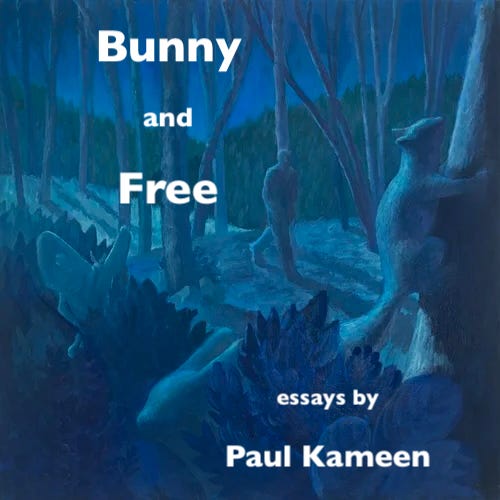
I just published the two-part book that brings together the essays “from both sides now” (the title of this essay, borrowed from Joni Mitchell’s great song) of my spring/summer writing-palooza. It’s called Bunny and Free, in honor of the “heroes” of each half: the poet Bunny Lang and my dream-friend Free. You can read it for free in PDF form on my website, paulkameen.com, or buy the paperback at cost on Amazon.com. Cover artwork by Joseph Kameen: a bunny, a moth, a squirrel scurrying up a tree, and maybe me, just walking through the woods. Free. At last. Again.
Deeply beautiful piece, Paul - in many ways, as are you.
Great to hear all of this, Paul. I won't make some stupid comment about your being "healed" or "complete" or anything that suggests your loss has been put forever in the past, but at the same time it's really special to read this essay and hear the lift in your voice, as if you're lighter now, moving at ease, finding your way with clear eyes. And congrats on finishing Bunny & Free--I can't wait to read it!